Showing posts with label Political Factors. Show all posts

Thursday, September 13, 2007

U.S. Senate Approves of Some Things, Disapproves of Others


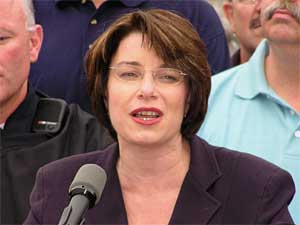
Yesterday the United States Senate passed a transportation spending bill that will now be returned to the House of Representatives for approval. The bill was passed without a proposed waiver of Davis-Bacon Act, a law that requires fair wages for federally-funded public works projects, for bridge renovation projects. The bill has added US$1 billion for such projects in an amendment to an earlier version. Funding was also augmented for the I-35W bridge due to efforts by the junior senator from Minnesota.

Thursday, August 16, 2007

New Biometric System Introduced at SFO


The new SFO fast-pass technology Clear was launched yesterday to much fanfare.

Clear is part of a new wave of biometrically-based technologies being deployed at airports across the United States. These technologies provide airport customers with expedited security lines in exchange for voluntarily submitting their fingerprint, iris, and retinal data, which are linked to the customer’s other personal information (see Airports International, vol 40 no 3 pp 28-39 for further information).

While the federal government monitors these programs under the Registered Traveler's program (RT), the creation of biometric databases is, apart for privacy issues, a cause for concern for some. One such critic is Italian philosopher Giorgio Agamben who notes that, when biometrics was first implemented, it was used solely for the control and regulation of recidivist criminals.

Tuesday, August 14, 2007

US DOT announces who gets the Urban Partnership money

The U.S. Department of Transportation announced today the five metropolitan areas to whom they awarded the Urban Partnership Agreements (UPAs). The winners are:

Each of the winners will still need to submit traffic studies for their respective projects before receiving the money. Twenty six cities applied for the the program's funding. New York's $354 million will go towards congestion pricing in Manhattan. Seattle will use its $139 million to charge tolls on the Highway 520 floating bridge. Miami's $63 million will go towards installing variably priced toll lanes on I-95 between Miami and Ft. Lauderdale. Minneapolis will spend use it's $133 million to add High Occupancy Toll lanes to I-35. San Francisco's $159 million will help establish a congestion pricing plan for the downtown area.

Friday, August 10, 2007

Creaking infrastructure


"A bridge too far gone" is the title of an article in the current Economist, describing the sorry state of America's transportation infrastructure and the country's shortcomings in transportation finance.

Wednesday, August 08, 2007

FAA Grant to Study Bay Area Airport Gridlock

The Metropolitan Transportation Commission will use a $585,000 grant from the Federal Aviation Administration to study ways to avoid gridlock at Bay Area airports. The SF Chronicle reports that among options to be considered are persuading airlines to resume flying larger aircraft, developing high-speed rail, expanding capacity at major airports, and better use of the area’s general aviation airports.

MTC’s most recent Regional Airport System Plan was updated in 2000 and also considers alternatives.

And to the south, passengers using Los Angeles International experienced flight delays in four of every five flights. But as the Los Angeles Times reports, that’s better than the national average of one in three. Overall system performance is so bad that fully one-third of all flights during January – June 2007 were late.

Saturday, April 21, 2007

From Beijing to Lhasa by rail

The controversial new railroad between Beijing and Lhasa, capital of Tibet, travels over some of the highest terrain in the world. At over 16,000 feet the oxygen content is just 45% of normal levels, and oxygen masks are supplied for passengers. John Flinn of the San Francisco Chronicle rode the train and filed an illustrated report in the November 5, 2006 Sunday issue.

More recently the New Yorker (April 16, 2007) published a longer article by Pankaj Mishra. It describes the author's train ride to Lhasa and ponders the political implications of the new rail link. An abstract is available.

Tuesday, August 22, 2006

Does your car have a Black Box?

The National Highway Traffic Safety Administration (NHTSA) announced yesterday that "automakers must inform customers if their vehciles are equipped with an Event Data Recorder (EDR)."
The new federal rule, which takes effect starting with model year 2011 cars, will require automakers who have chosen to install EDRs to note in the owner’s manual that the safety monitoring equipment has been installed.

The rule also includes new requirements designed to ensure that the data collected by EDRs can be used to improve highway safety. For example, the rule requires EDRs to be more durable to protect data during a crash. The rule also requires automakers to collect the same type of crash data if they chose to install an EDR (see attached list for all data elements).

A pdf of the full notice can be found here.

via /.

Friday, April 21, 2006

Is your city ready for an oil crisis?

Recently SustainLane released their study naming the 50 largest cities prepared for an oil crisis. The top ten cities are:
  1. New York

  2. Boston

  3. San Francisco

  4. Chicago

  5. Philadelphia

  6. Portland

  7. Honolulu

  8. Seattle

  9. Baltimore

  10. Oakland

It's nice to see both San Francisco and Oakland in the top ten. The rest of the list can be found here.