Showing posts with label Transportation Futuristics. Show all posts

Thursday, March 27, 2008

Peak Oil and the Future of Transportation

photograph courtesy of flickr

The current issue of Cal Transit's Transit America serial has an interesting article on the issue of peak oil (here on p 7, in PDF). The article, written by the mayor of Huntington Beach, California, Debbie Cook, opens with the following:
Core to all U.S. transportation planning is the assumption that oil will always be abundant and cheap. This premise continues to dominate every regional transportation plan in the country and drives our auto-centric development patterns. But what if this assumption is wrong? What if we are near the peak of world oil production? It then follows that our assumptions on construction costs, gas tax revenues, travel and aviation demand, mode choice, and growth patterns are also wrong. It would mean that our fossil fuel-based energy future is in jeopardy and that we are not prepared.
Cook then goes on to provide some quantitative metrics indicating that the global community is indeed already in such a situation. Peak Oil, Cook explains, will yield a problem for transportation energy of a magnitude such that the United States' federal government will have to initiate policies to strongly militate against potential catastrophe.

A more passionately articulated position can be found in J.H. Kunstler, whose website can be found here. His book, The Long Emergency, speculates on this potential catastrophe and demonstrates to readers just how deep runs the modern world's dependence on oil as an energy resource.

-J. Chipman

Monday, January 14, 2008

Flying Car Sells for $131K

The winning bid for the Sky Commuter prototype which sold on ebay this morning was $131,700.00. This vehicle is the only one remaining of the three which were built by Boeing in the 1980s at their Arlington, Washington facility, the other two having been scrapped when the $6 million Sky Commuter project was dismatled. The one seen here was saved from the scrapyard because it was not onsite at the time. Its sister ships have actually gotten off the ground -- about 10 feet off the ground, although this one is not flyable. The other two prototypes were damaged during testing and the original electric motors on this one were replaced with less powerful motors to prevent its getting off the ground. A former employee of Payne Aerospace writes, "ALL the flight tests were crash failures. They had overcome many issues but could not get away from power/rate/control issues. Years of testing, never a safe mode flight."

Wednesday, September 26, 2007

Catch a ride in a Cybercar

Tired of driving the same old way? Want a new form of mobility that bridges the gap between an automobile and public transportation? Can you envision yourself in a cybercar? See what the Europeans are doing ... and will it ever catch on in the U.S.?

Tuesday, September 11, 2007

Some new and old wonders


The current issue of the Economist's Technology Quarterly contains some interesting items on innovations in transportation, including German research in small hovercraft, news of a sea-going automobile, and the story of the introduction of electric buses in London a century ago.

(Picture courtesy of The Economist)

Thursday, September 06, 2007

The End is Near

Reuters reports today that the United States gasoline supply has hit a 2-year low. While the article explains a dip in supply often happens at the end of the summer, long-term fossil fuel availability is the subject of much speculation. J.H. Kunstler is one such speculator and his recent book, The Long Emergency, envisions a future without petroleum-based transportation (here is a teaser of his dystopian vision).

Contra Kunstler, Robert Bruegmann of the University of Illinois argues in his book Sprawl: A Compact History that the benefits to a society from petroleum use greatly outweigh the risks. It is also argued that concerns regarding petroleum use are exaggerated. Kunstler's rebuttal can be found here.

Wednesday, September 05, 2007

A 'Brave New World' of Telecommuting

TheRecord.com has a story on a Halifax, Nova Scotia man who uses an automaton as a proxy at his office in Waterloo.

The man's coworkers have adjusted well to their new robotic overlord.

Friday, August 31, 2007

Flying cars and airborne saucers

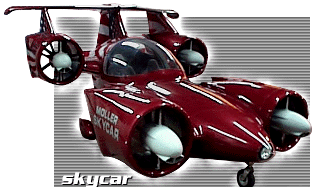
A page from the BBC highlights the research of aviation engineer Dr. Paul Moller and his prototype of a flying car, which he sees as an answer to traffic congestion. The small VTOL craft ascends to just ten feet off the ground. Moller, based in Davis, California has been building and researching unusual aircraft for many years. In 1967 he developed a saucer-shaped hovercraft, as shown in a page from the Transportation Futuristics online exhibit.

(Picture courtesy of the BBC)

Tuesday, August 07, 2007

Highways are a Series of Tubes

Senator Ted Stevens said "The Internet is a series of tubes."
Prof. Carl Ross from University of Portsmouth would like to see highways as a series of tubes.
Professor Carl Ross's innovative concept for an enclosed 'double-decker highway' would not only help cut road congestion but also significantly reduce the levels of harmful gases emitted by cars being released into the atmosphere.

Open double-decker highways already exist in Mexico City, but the mechanical engineer's vision sees the roads walled and roofed in soundproof plastic to trap carbon dioxide.

The poisonous emissions would then be blown into filters or 'scrubbers' much like those used on submarines and space shuttles for decades.

Wednesday, April 25, 2007

More predictions from the past

Transportation futuristics from the Paleo-Future site. Marvel at all the people in 2000 wearing 19th-century clothes as they walk on water, soar through the air on personal flying machines, travel on moving sidewalks and enjoy televised opera concerts.

Saturday, April 21, 2007

Futuristics

If you liked the previous entry on technological forecasts from 1900, you may well enjoy Engineering Futuristics, an online exhibition of weird and wonderful transportation ideas from the past. Assembled by our Operations Manager Paul Hernandez from items in the Transportation Library's collections, the physical exhibition was originally displayed in the lobby of UC Berkeley's Main Library. It reopened on Cal Day, April 16, 2005 on the ground floor of the breezeway between McLaughlin Hall and O'Brien Hall.

Paul talks about the exhibition in an interview in the online magazine The High Hat.

Thursday, April 19, 2007

Looking forward from the year 1900

Futuristics from the December 1900 issue of the Ladies' Home Journal, in an article titled “What May Happen in the Next Hundred Years" by John Elfreth Watkins, Jr. What's interesting is that the author and his consultants ("the wisest and most careful men in our greatest institutions of science and learning") got quite a few things correct, though they missed out on the airplane.

Here's a facsimile of the original article.

Friday, October 20, 2006

Buy a (Non-flying) Piece of Aviation History


Bidding on eBay has reached more than $3,000,000 for an unflyable, undriveable M400X Skycar prototype from Moller International of Davis, California. The brainchild of Paul Moller, it's been in development for years but is still neither sky- nor road-worthy. Flight tests have tantalized some investors, however, and the company has successfully spun off research into rotary engines using ethanol.